
Essay: A Swallowtail Question
6/11/2000

From Blue Ridge Country
A Swallowtail Question
by Elizabeth Hunter
The teacher’s note was urgent. A black swallowtail butterfly, misinterpreting the artificial heat in her second-grade classroom for the coming of spring, had emerged prematurely from its chrysalis. The month was February; the classroom in Illinois. Posted to a monarch discussion group on the internet, the message was somewhat off-topic, though I doubt anyone minded. If you care about monarchs, chances are you care about swallowtails too. The children in her class, the teacher wrote, had found the caterpillar eating parsley in the school’s butterfly garden the previous fall, brought it inside, and fed it until it pupated. Most likely, after that it probably slipped everyone’s mind until the day when the butterfly cast off its chrysalis husk and pumped up its ebony wings.
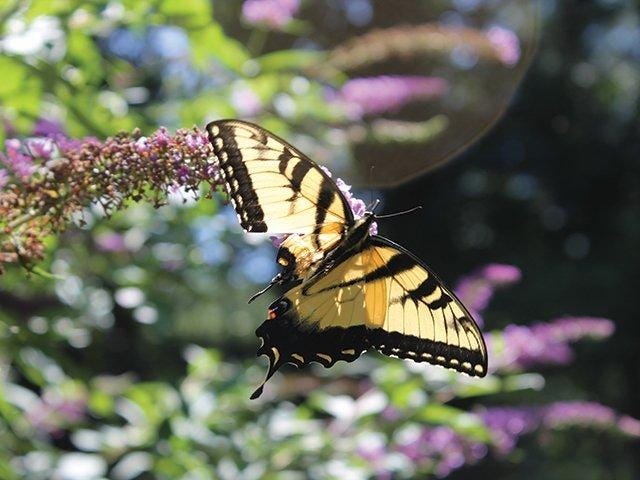
The teacher and students did what they could for it. They mixed up some sugar water to serve as a nectar substitute. The swallowtail wasn’t interested, though the teacher had kept a monarch with a broken wing alive for weeks with a similar concoction. The children were so worried that they tried to comfort the butterfly by reading it stories. This was not the teacher’s idea — she’d had to ask what they were doing when she noticed a cluster of kids by the butterfly cage, reading aloud. Apparently, hearing a story made the children feel better when they were worried about the big, bewildering world they found themselves in, and they thought the swallowtail might be like them in that respect.
The children didn’t forget the butterfly’s plight when they went home, either. At least one told his or her father about it. That child’s father had a solution. He was an airline pilot, with upcoming flights to Tampa, FL, and Oakland, CA. “The pilot is willing to take the butterfly (to) either place and release it in a warmer climate. Would this be a good idea?” the teacher asked. I hoped the answer would be yes, though I suspected it wouldn’t be. Sure enough, several scientists explained why relocating the swallowtail would be a bad idea. It could endanger resident swallowtail populations wherever the pilot took it. It might be carrying a disease or harboring a parasite to which butterflies in Florida or California had not previously been exposed. Turn down the offer, several scientists counseled.
I don’t know whether the teacher took the advice, though I think she probably did. Why otherwise would she have asked the question? She knew she’d made one mistake — not finding out how a chrysalis should be cared for over the winter — and didn’t want to compound it by making another. I admire her for that.
I know it’s painful to think of a butterfly trapped — through no fault of its own — in a classroom in the depth of winter, a butterfly with no hope of finding a mate, or flying free, or basking in the sun. It’s painful, too, to realize how heavy the heart of that teacher must have been when she read the answers to her question. Imagine having to look into the upturned faces of a classroom full of seven-year-olds and tell them that, for the swallowtail they loved, there would be no escape. That it would have to live — and die — right there in their midst.
That’s just one way to look at this story. There are others. Think, for a minute, of the opportunity that swallowtail afforded those children to learn all kinds of real, meaningful lessons, not only about science and ecology, but about compassion and caring, about life and death. Not the kind of lessons that helped them score higher on standardized tests. But the kind those children will need under their belts when they inherit the impoverished world our generation of getters and spenders will leave them, no matter how high the Dow climbs or how low it falls.
Then there’s the matter of the swallowtail itself. Surely the teacher tinkered with the sugar water mixture until she got the proportions to the butterfly’s liking, or found some flowers for it at a florist’s. Temperatures might have been nicer for butterflies in Florida or California. But car windshields aren’t any softer, or pesticide sprays any less lethal to “non-target species” than they are in Illinois. And surely the children kept reading it stories. (That teacher would have understood that it was not just the swallowtail that needed to be consoled.) Isn’t it heartening, in an age when the written word is being eclipsed by videos and virtual reality, to know that a group of small children recognized, on their own, the inherent power of story, of the written word?
And what about pilots? Doesn’t this story cast them in a different light? Several times a year, I fly to Vermont to visit family. Sitting in airports, I’ve watched plenty of pilots walk by. Buttoned into those uniforms, they look so cold, official, remote. Before reading the swallowtail question, I couldn’t conceive of their other lives — of them asking their kids about school, or tucking them into bed, maybe singing them a go-to-sleep song the way my father did when I was a little girl. I couldn’t imagine a child delivering an impassioned plea to a pilot about a butterfly born out of season. Now I can.
Finally, there’s this. On a break from writing the other day, I took a walk outside. In my garden, I spotted a black swallowtail. She was swirling around the fennel plants in the sunlight. As I watched, she alighted and touched the tip of her abdomen to their fragrant, feathery leaves to deposit a tiny, pearl-like egg. She lifted off, danced around the plant, laid another, and another, and another. That Illinois swallowtail wouldn’t have lasted more than a couple months, no matter what heroic measures were taken on its behalf. But here in the Blue Ridge, up in Vermont, out there in the vast flat stretches of Illinois, its kinfolk are gracefully, gorgeously, gloriously alive.